
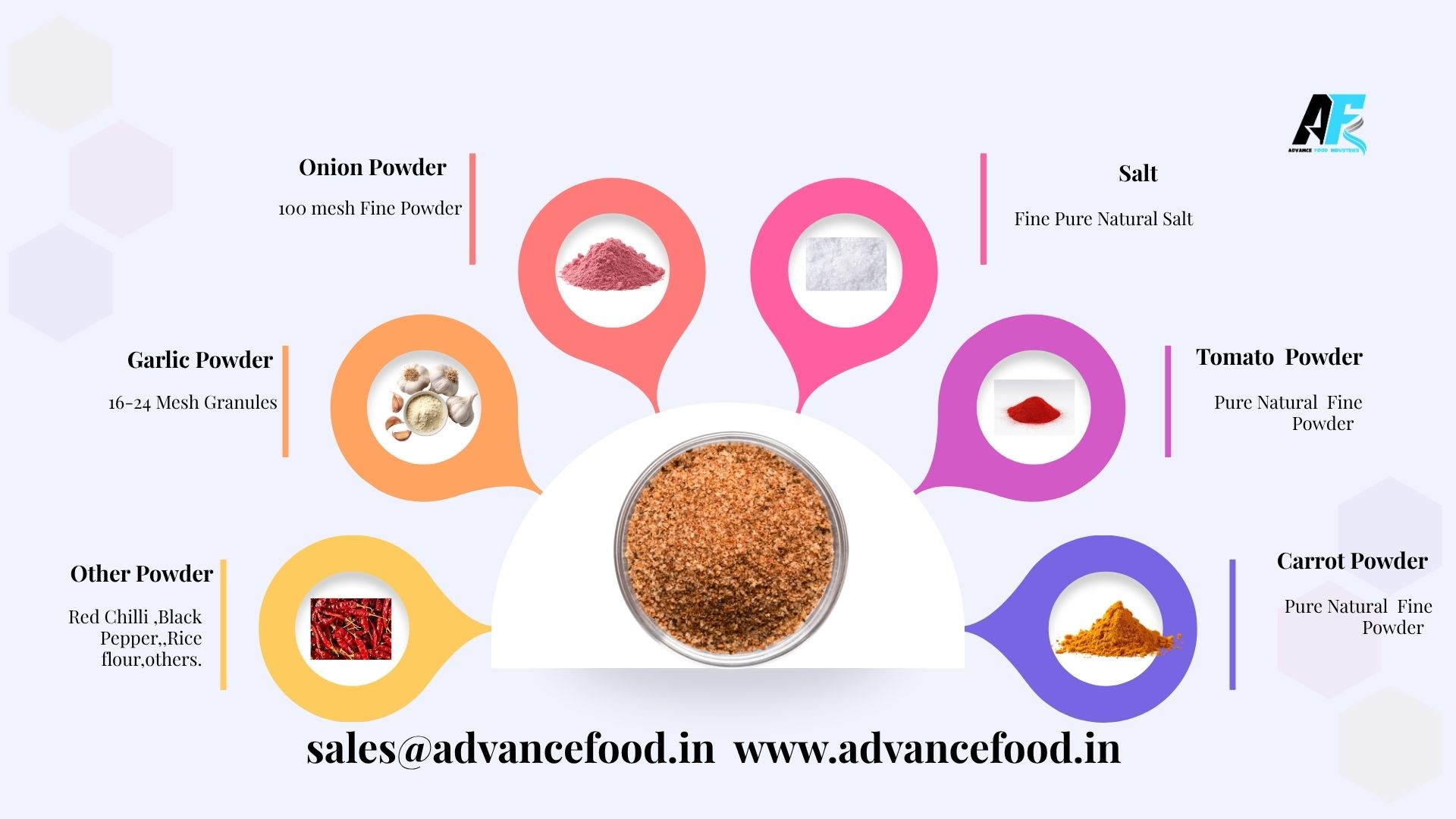
A good seasoning blend serves a specific purpose : it gives food a "finished" flavor,sparing the cook from having to worry about achieving that balance themselves. For a long time, this meant relying on a base of salt,monosodium glutamate (MSG) and artificial coloring. But that is changing.Buyers,retailers and home cooks are now reading labels ; being "Natural" has shifted from being an added benefit to a fundamental requirement. The good news is that it is possible to create seasoning blends with great depth using only dehydrated vegetable powders,spices and salt.
This guide explains how to do it : what each powder contributes, how to establish initial ratios,how to ensure a uniform blend and where things usually go wrong. It is intended for anyone developing a line of seasonings from a restaurant group creating its own signature blend to a brand launching its own product range.
Why are vegetable powders a good base ?
Dehydrated vegetable powders are simply vegetables with the water removed,while their flavor,color and aroma remain intact.This concentration is precisely what makes them so useful.A single spoonful of onion or tomato powder delivers the essence of a large quantity of fresh produce without the hassle of peeling,chopping or the risk of spoilage and it remains in perfect condition for months.
For natural seasoning blends,this offers four distinct advantages :
Depth of flavor : Onion and garlic provide a savory foundation ; tomato adds a touch of acidity and Deliciousness,while carrot contributes a gentle sweetness.Together, they function just as effectively as traditional flavor enhancers.
Color without artificial dyes : Tomato provides a warm red,beetroot offers a more intense pinkish-red,carrot imparts a golden-orange tone and spinach provides a green color.Since color is a crucial factor in purchasing decisions,vegetable powders allow for achieving this naturally.
A cleaner label : A blend with an ingredient list consisting of items like onion,tomato, garlic,carrot,salt and pepper is far more appealing to consumers than one containing a long list of additives.
Consistency : Dehydrated vegetable powder,prepared according to precise technical specifications,ensures that the product maintains uniform characteristics across every batch.This becomes extremely important when a product is to be manufactured consistently,even more so than when preparing a dish at home.
Understand the function of each ingredient.
Before developing a formula (recipe),visualize the mixture as a team,where every member has a specific role.
An excess of any particular component or function is the most common reason why a dish might turn out flavorless on the first attempt or why the individual flavors fail to stand out clearly.
Ingredient | Main role | What to watch |
|---|---|---|
| Onion powder | Savoury backbone, sweetness when cooked | Strong; easy to overdo |
| Garlic powder | Sharp, aromatic punch | Can turn bitter or harsh in excess |
| Tomato powder | Tang, umami, red colour | Very hygroscopic; clumps easily |
| Carrot powder | Mild sweetness, orange colour, body | Can make a blend taste sweet if overused |
| Beetroot powder | Deep red colour, earthy note | Strong colour and flavor; use sparingly |
| Spinach powder | Green colour, mild vegetal note | Colour can dull to olive over time |
| Chilli powder | Heat and red colour | Heat level varies by type |
| Salt | Flavor carrier, preservation | Dominates quickly |
| Pepper, cumin, turmeric | Aromatics and warmth | Small amounts go far |
If you would like more details on how to adjust the level of spiciness,our previous guide on red chili powder and SHU (Scoville Heat Units a unit for measuring heat) will be helpful,as both the spiciness and the color depend on the type of chili used.
Start with two initial blends (formulas)
These serve as starting points for your experiments,they are not final or fixed recipes. The percentages provided here are based on weight. Before using these blends in your final product,you should test them and make any necessary adjustments.
Always prepare the blends based on weight rather than volume, as the density of each powder varies.
Flavorful Blend for Daily Use (All-Purpose)
Onion Powder: 25
Tomato Powder: 20
Salt: 25
Garlic Powder: 10
Carrot Powder: 10
Pepper (Black Pepper): 4
Turmeric: 2
Rice Flour (Optional): 4\Red Masala -Style Base Blend
Tomato Powder: 25
Onion Powder: 20
Salt: 25
Garlic Powder: 8
Kashmiri-Style Chili Powder: 8
Beetroot Powder: 5
Cumin: 5
Rice Flour (Optional): 4
In the second blend,beetroot is used for its color,not for its flavor. A small amount deepend the red color of the blend without imparting any distinct earthy taste.If you wish to increase the heat while maintaining the color,replace a portion of the Kashmiri chili powder with a spicy chili powder,simply increasing the amount of Kashmiri chili powder alone will not achieve this.If you wish to reduce the salt content,you can lower the amount and compensate by slightly increasing the quantity of tomato and onion powder, which adds depth to the flavor. Make these adjustments gradually and taste the mixture at each stage,as salt also influences how other flavors are perceived.
Match Particle Size Before You Mix
This is a step that is frequently overlooked,yet it is actually the root cause of most issues.If one ingredient consists of larger particles (granules) while another is a fine powder, they will eventually separate : the fine powder will settle at the bottom of the container, while the larger particles will rise to the top.Consequently, the first spoonful of the mixture will taste different from the last.
Aim for a consistent particle size across all ingredients. A mesh size of 60 to 100 is a common choice for vegetable powder blends,as this ensures even distribution and good solubility.In our article on powder 'mesh size' (which uses onion powder as an example), we explained what these figures signify in terms of actual texture.If you wish to achieve a specific texture in a blend,such as small pieces of carrot or bits of onion add them intentionally and in small quantities ; also, keep in mind that they may settle to the bottom to some extent.This issue can be mitigated by mixing larger particles with a denser base ingredient, or by packaging the blend into smaller units.
Blending: A Step-by-Step Approach
Adding all ingredients into the mixer at once often leads to poor results,especially when some ingredients are used in very small quantities.
Instead, follow these steps :
- Start by combining the main ingredients,such as onion,tomato and salt in a clean,dry mixer.
- Create a pre-mix by blending ingredients like turmeric,beetroot and pepper with a portion of the main mixture. This ensures that potent ingredients,used in small amounts, are distributed evenly.
- Incorporate this pre-mix into the main batch and complete the blending process.
- Shift the final mixture to remove any lumps before proceeding to packaging.
Blend for long enough to achieve a uniform distribution, but avoid over-processing, as this can generate heat or cause the powder to compact. Before finalizing the batch, take several samples from different points and compare them for both color and flavor.
Moisture Control : The Enemy of Any Dry Mix
Dehydrated vegetable powders are hygroscopic.they absorb moisture from the environment and some do so more rapidly than others.Tomato and beetroot powders are often the most problematic due to their natural sugar content. A mixture that flows perfectly on a Monday can turn into a solid block by Friday if left exposed in a humid environment.
Adopting specific practices can make a significant difference. Before purchasing,check the moisture specifications for each powdered ingredient and request a Certificate of Analysis from your supplier to understand the characteristics of the raw materials.Work in a cool,dry environment and keep containers closed between each stage of the process.Use packaging materials that act as a moisture barrier. For large batches or products intended for export,consider using sealed protective bags or nitrogen-flushed packaging. Additionally, keep finished blends away from heat,steam and direct sunlight.
Regarding anti-caking agents : Adding a small amount of rice flour or a similar natural carrier can help the mixture remain free-flowing ; however,this means your ingredient list will no longer consist solely of vegetable powders.If your value proposition is based on offering only vegetables,spices and salt. you might choose to manage flowability through strict moisture specifications and an improved packaging system, rather than by adding other ingredients. Make this decision as early as possible, as it will impact both your product formulation and its labeling.
Color : How to Achieve and Maintain It
Color contributes to a product's appeal,yet it is often the first quality to change over time. Light,heat and air cause natural pigments to degrade.
Tomato,carrot and chili peppers retain their color well when stored properly.Beetroot provides an intense red color,though the exact shade may vary.Spinach is the least stable ; its green color tends to fade and shift toward an olive tone,especially in blends that are stored for months or exposed to light.If you desire a green-colored blend, opt for opaque packaging,consider a shorter shelf life (or both) and evaluate the product's appearance at the end of its intended storage period,rather than on day one.
Common Issues and Solutions
The blend clumps in the pack : This is almost always due to a moisture-related issue.Monitor the moisture content of your ingredients,optimize the conditions of the packaging environment and review the barrier properties of your packaging materials.
It tastes flat : This is typically due to an insufficient amount of onion or tomato relative to the salt or because the ingredients have lost their freshness. Adjust the recipe by strengthening the flavor base, and check the age of any powdered ingredients.
The flavor is too strong or bitter : There is likely an excess of garlic or pepper. Reduce these quantities slightly, and allow the onion and carrot to mellow the flavor profile.
The flavor is too sweet : The carrot or tomato is too dominant. Reduce the quantity of one of these, and add a bit more onion or a touch of spices.
The color deteriorates rapidly : Check for exposure to light and evaluate the type of packaging used. Use opaque packaging, and avoid using unstable pigments—such as those derived from spinach—in products intended for a long shelf life.
The flavor varies between different packages : This is caused by the segregation of ingredients. Ensure that the particle size (granulometry) is uniform and employ a multi-stage process for mixing.\
Testing Before Scaling Up
Never judge a blend solely by a spoonful of the dry powder. Test it in the specific application for which it was designed add it to a sauce,soup,marinade or snack coating,using the intended ratio.Factors such as salt,heat and fat can alter how the blend is perceived.Conduct small-scale shelf-life testing by storing sealed samples under typical conditions and periodically evaluating them for color,aroma,flowability and moisture content.For commercial products also verify microbiological safety and moisture levels through laboratory analysis additionally,ensure that the labeling complies with the food regulations of the markets where the product will be sold.If you plan to export,research the requirements of the destination country in advance including customs classifications for dehydrated vegetable blends.
Sourcing Is Just as Important as Formulation
A lack of uniformity in raw materials can ruin even a well-designed blend. When buy dehydrated vegetable powders,request clear specifications for each product covering moisture content,granulation (particle size),color and microbiological limits supported by a Certificate of Analysis (CoA) for every batch. A (Advance food) reliable supplier of bulk vegetable powders should be able to provide this information consistency in supply is just as important as price,ensuring that the product maintains a uniform flavor profile over time.If you are developing a product line,begin with small quantities for testing to verify that the blend performs as expected, then scale up production volume while maintaining the same specifications.
Conclusion
Creating natural seasoning blends from dehydrated vegetable powders is not a complex process, but it does require discipline. Assign a specific function to each ingredient, establish proportions by weight,ensure uniform particle size,execute the blending process in stages and remain vigilant regarding moisture,which poses a constant risk. Test the blend in its final application,monitor color and flowability over time and collaborate with suppliers capable of supporting your product with technical data.By following these guidelines,you will achieve clean label seasonings with complex flavor profiles an appealing appearance and consistent performance across every production run exactly what both consumers and production lines are looking for.
FAQs
- What are the best dehydrated vegetable powders for natural seasoning blends ?
Dehydrated onion powder, garlic powder, tomato powder, beetroot powder, and other vegetable powders can add flavour, colour, and versatility to natural seasoning blends. - How do you make a natural seasoning blend with dehydrated onion and garlic powder ?
Combine dehydrated onion powder and garlic powder with selected herbs, spices, salt, and other ingredients according to the desired flavour profile. - What are the benefits of using dehydrated vegetable powders in seasonings ?
Dehydrated vegetable powders provide concentrated flavour, convenient handling, consistent blending, and easier storage than fresh vegetables. - Which onion powder mesh size is best for seasoning blends ?
80–100 mesh onion powder is often suitable for fine seasoning blends, while coarser grades may work better for textured applications. - Why is dehydrated garlic powder used in natural spice blends ?
Dehydrated garlic powder adds a characteristic savoury flavour to seasonings for snacks, soups, sauces, marinades, and ready-to-cook foods. - Can tomato powder be used in natural seasoning blends ?
Yes, dehydrated tomato powder adds tomato flavour, colour, and acidity to snack seasonings, soup mixes, sauces, and savoury blends. - How do food manufacturers choose the right vegetable powder for seasoning ?
Manufacturers should consider flavour intensity, particle size, moisture content, colour, solubility, and compatibility with the final product. - Are dehydrated vegetable powders suitable for snack seasoning manufacturers ?
Yes, onion,garlic,tomato and selected vegetable powders are widely used in seasonings for chips,namkeen,extruded snacks and other savoury products. - How can natural seasoning manufacturers maintain a consistent flavour ?
Use standardised recipes, consistent ingredient grades, controlled mixing procedures and regular quality checks on incoming vegetable powders. - What is the difference between dehydrated vegetable powder and fresh vegetables in seasoning production ?
Dehydrated vegetable powder offers lower moisture, easier storage, and convenient dosing, whereas fresh vegetables contain more water and require additional processing. - How should dehydrated onion and garlic powders be stored ?
Store them in sealed, moisture-resistant food-grade packaging in a cool,dry place to help preserve flavour and quality. - Can dehydrated vegetable powders be used in salt-free seasoning blends ?
Yes, onion powder, garlic powder, tomato powder, and herbs can help develop flavourful seasoning blends without added salt. - What quality specifications should buyers check when purchasing bulk vegetable powders ?
Check moisture content, particle size, colour, flavour, microbiological parameters, foreign matter, packaging, and the supplier's technical specification sheet. - Where can food manufacturers buy bulk dehydrated onion and garlic powder in India ?
Food manufacturers can contact suppliers such as Advance Food Industries in Gujarat to enquire about available grades, bulk quantities, product specifications, and commercial pricing. - How can manufacturers develop a customised natural seasoning blend ?
Start with the target application and desired flavour, select suitable dehydrated vegetable powders and spices, conduct small-batch trials, and adjust the recipe based on taste, texture, and stability testing.