Most people outside this sector may not have even heard of Isabgol.Even many professionals associated with the health and wellness industry use it, yet they may not be aware of its origins.It is found in products such as fiber supplements,gluten-free bread and breakfast cereals. it sits on the shelves of pharmacies ranging from Texas to Toronto.A significant portion of this product originates from the arid agricultural regions of Gujarat and Rajasthan.
The export of Isabgol is a story from the Indian agricultural sector that rarely makes headlines, as it generates little discussion or fanfare.There are no festivals celebrated in its honor,nor are there any well-known consumer brands associated with it. Nevertheless,from a commercial perspective, it serves as an excellent case study of how a specific region,a unique crop and a commercial ecosystem can maintain a leading global position for decades. Below, we will explore how this process functions,what buyers are actually looking for and where opportunities still exist for exporters.
What exactly is 'Isabgol' ?
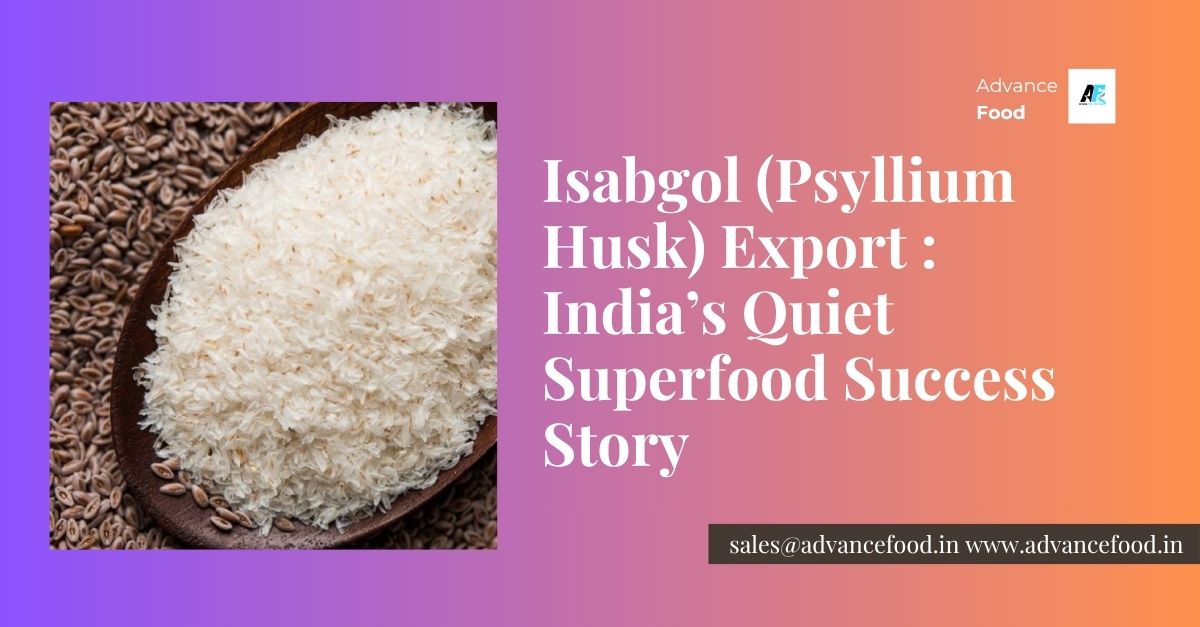
Isabgol known internationally as 'psyllium husk' or 'ispaghula' is derived from the seeds of a small plant called Plantago ovata. While the seeds themselves are very small, their true value lies in their outer covering or husk. Upon contact with water,this husk swells to form a soft,jelly-like substance.It is this property that makes psyllium so useful : as a natural soluble fiber,it is utilized in products designed for digestive health ; in the food industry,it serves as a binding agent and helps improve texture and it is also a key ingredient in the production of gluten-free food products.
Commercially,three names are used for this single product : Isabgol,psyllium husk and ispaghula.These are not distinct products ; Isabgol is the term used in India, whereas psyllium is the term commonly used internationally.Any differences arise solely from the form such as whole seeds,husks or powder as well as the specific grade or quality of the product.
Why is India a leader in the global market ?
According to industry sources,India accounts for 80 to 90 percent of the global production and processing of 'Isabgol' (psyllium). These sources estimate the annual value of Isabgol exports from India to be between 250 and 300 million US dollars,with nearly half of this volume destined for North America.These are commercial estimates not official,government-audited figures and should therefore be viewed only as an indication ; nevertheless,all sources agree on one point : India dominates the market.
There are three main reasons for this position:
- Climate and Soil : Plantago ovata is a winter crop that requires a cool,dry climate and well-drained sandy soil.Northern Gujarat and the adjacent regions of Rajasthan provide an ideal environment for this.Furthermore, rainfall during the harvest period can damage the crop, as moisture can cause the seeds to spoil.Consequently, the success of the crop in any given year depends significantly on the weather conditions during the final week of the harvest.
- A Hub for Trade and Processing : The region of Unjha and Siddhpur in North Gujarat serves as the primary hub for the global Isabgol (psyllium) trade.Unjha is home to one of Asia's largest agricultural markets and it is here that the benchmark prices for Isabgol are largely determined.In practical terms, virtually anyone purchasing Isabgol globally does so through this central hub.Such concentration offers clear advantages : experienced processors,skilled workers,machinery suppliers,brokers and logistics services are all available in one place.
- Decades of processing experience : Producing pure, lustrous, and high-quality 'husks' from raw seeds is no simple task; the Indian industry has mastered this process through the hard work of generations.
From Farm to Husk : How is Isabgol Processed ?
This crop is typically sown during the winter season and harvested in the spring. After harvesting, the plants are dried and the seeds are separated ; these seeds are then cleaned and graded.The most critical stage of this process is milling during which the outer layer (husk) is mechanically separated from the seed.The husks account for a relatively small portion of the seed's total weight typically around one-fourth.which is one of the factors influencing the cost of the final product.
Once separated from the seeds,the husks undergo repeated sieving,air-purification and often color-sorting to remove any remaining seed fragments,dust and other impurities. The cleaner the husks,the higher their purity and the whiter their appearance.Some of these husks are ground into a powder with specific particle sizes,catering to customers who require a very fine ingredient that dissolves quickly.
Other by-products derived from this process are also significant.The remaining seed material is utilized for purposes such as animal feed,which contributes to the overall economic viability of the business.
Levels of Purity and Their Significance
When reviewing the technical data sheet from any Isabgol (psyllium) supplier,the first detail that catches your attention is the degree of purity. Typically, this is represented by levels such as 85%,95%,98% and 99%.some suppliers even offer a purity level of 99.5%. Here, purity refers to the actual proportion of Isabgol husks in the product, as well as the minimal presence of impurities such as seed fragments,dust or sand. Higher-grade Isabgol is whiter and cleaner and it also commands a higher price.
| Grade | Typical positioning |
|---|---|
| 85% | Lower-cost applications, some industrial uses |
| 95% | General-purpose food and feed use |
| 98% | Common export grade for food and supplements |
| 99% and above | Premium grade for pharma, nutraceutical, and high-end food |
An important note for new buyers and exporters : The concept of purity is not defined the same way by everyone. Some suppliers determine it through sieving and grading processes,while others use laboratory methods. Always ask how a given figure was determined and ensure it is supported by a Certificate of Analysis ; do not simply compare percentages provided by different suppliers,as they may not always represent the same thing.
Another indicator : Swelling Index
While purity indicates how clean the husk is,the swelling index indicates its effectiveness.This parameter measures the extent to which the husk expands upon contact with water,typically expressed in milliliters per gram.For husk with 99% purity,suppliers often report values between 35 and 40 milliliters per gram ; some figures may be even higher,depending on the analytical method used and the specific sample.
For a buyer producing supplements,baking mixes or fiber-rich beverages,the swelling index directly impacts product yield and the required dosage.Two batches with the same purity level may have different swelling indices ; For this reason,professional buyers request both data points.
Where does the demand come from ?
One of the key aspects of psyllium is the wide variety of sectors in which it is used :
- Nutraceuticals and pharmaceuticals : By most estimates, this is the most significant segment.Psyllium is an established soluble fiber ingredient used in products designed for digestive health,sold in the form of powders,capsules,wafers or sachets. In the United States,regulatory authorities have long permitted specific health claims regarding cardiovascular health linked to the soluble fiber found in psyllium husks ; this has enhanced its credibility among both consumers and brands.
- Functional and gluten-free foods : Due to its gelling capacity,psyllium serves as a valuable binding and texturizing agent in gluten-free breads and baked goods,helping to recreate the texture typically provided by gluten.It is also found in cereals,snack bars and high-fiber food products.
- Dietary supplements and wellness : With growing interest in gut health and fiber intake, there has been an increased demand for psyllium in powdered beverage mixes and daily dietary supplements.
- Animal and pet nutrition : a small yet significant segment utilizes psyllium in products designed to support the digestive health of animals and pets.This diversification spanning the pharmaceutical,food and wellness sectors is the primary reason for the market's resilience ; a downturn in any single sector rarely impacts all other sectors simultaneously.
What International Buyers Evaluate
Any importer evaluating Isabgol (Psyllium) will adhere to a standard set of criteria :\
- Purity and Appearance : Cleanliness and color are analyzed high-quality products appear whiter and more uniform.
- Swelling Index : A performance metric measured in water.
- Moisture Content : A maximum limit of 10% to 12% is typically specified stricter limits are often preferred, as moisture affects shelf life and can lead to clumping.
- Mesh Size (Particle Size Distribution) : For powdered products, buyers specify the particle size, which can range from a coarse texture to a 100-mesh fineness.Our previous guide on mesh size explains how a finer grind influences dispersion and texture.
- Safety Analysis : Testing for pesticide residues and heavy metals, as well as compliance with microbiological limits, are standard requirements especially for clients in the pharmaceutical and supplement sectors. Furthermore, destination markets such as the European Union and the United States impose very strict limits. Reliable exporters provide batch-by-batch analysis rather than relying on general assurances.
- Shelf Life and Storage : When packed correctly—kept dry and sealed—psyllium husk typically has a shelf life of approximately two years.
- Documentation and Certifications : Buyers generally request a Certificate of Analysis, a Phytosanitary Certificate, and a Certificate of Origin. Depending on the destination market, they may also require certifications such as ISO, HACCP, Halal, Kosher, or FSSAI. Consult your customs advisor regarding the current tariff classification (HS Code) for your specific product, as this may vary depending on whether it is in the form of husk, powder, or seeds.
- Packaging and Transport : Psyllium is a lightweight yet bulky product that is highly sensitive to moisture; even a small amount of water can cause swelling or lead to the growth of mold. For export, moisture-resistant multi-layer sacks or lined cardboard boxes are typically used a standard bulk format transported in dry containers. When working with fine powder,careful handling is essential,as it generates dust and can clump together if exposed to moisture.
Challenges Not Mentioned in Brochures
The strength of this sector brings with it real risks ; maintaining a realistic perspective helps exporters plan more effectively.
- Price Volatility : The price of Isabgol can fluctuate significantly from one season to another, depending on harvest volumes,weather conditions and demand. Exporters who commit to long-term fixed prices without hedging their supply risks may find themselves in a difficult position.
- Dependence on Weather Conditions : Untimely rain can damage a large portion of the crop.
- Discrepancy Between Stated and Actual Quality : Since it is easy to claim a specific purity grade but difficult to verify it, buyers sometimes receive shipments that fall short of what was promised. This poses a reputational risk for all stakeholders in the sector; therefore, conducting proper testing and establishing clear specifications distinguishes serious exporters.
- Increasingly Strict Regulations : Regulations regarding residues and contaminants in major markets are becoming increasingly stringent,making process control and laboratory analysis a necessity rather than an option.
Where does the opportunity lie ?
- Given that India already supplies the majority of the world's Psyllium(Isabgol), the question is not merely about exporting, but rather how to move up the value chain. There are several compelling avenues to consider:
- High-quality grades and custom specifications : Premium products with a purity of 99% or higher,tailored particle sizes (granulometry) and strict specifications regarding moisture content and swelling capacity geared toward clients in the pharmaceutical and nutraceutical sectors.
- Value-added products : Powders,granules and blends rather than just raw husks (tegument).
- Private labeling and contract manufacturing : Supplying brands that market finished or semi-finished products under their own names.
- Market diversification : While North America has traditionally been the largest buyer,Europe,the Middle East,Latin America and various regions across Asia continue to offer significant growth potential.
- Traceability and certification : Buyers increasingly demand to know the origin of the harvest and how it has been handled ; exporters capable of documenting these details possess a competitive advantage.
For an exporter dealing in spices or herbal ingredients,Isabgol fits naturally into their existing product portfolio,as there is significant overlap in terms of the buyer base,required documentation and quality standards.
Conclusion
The case of Isabgol in India serves as an excellent example of a competitive advantage built over time : an ideal environment,a robust trading and processing ecosystem centered around Unjha and Siddhpur and generations of technical expertise in transforming small seeds into a clean,high-performance,fiber-rich ingredient. This is why India supplies a major share of the global Psyllium market and why buyers in the pharmaceutical,nutraceutical and food sectors continue to turn to the country. For exporters,the path forward lies not in competing on volume,but in offering reliability : verified purity,a precise swelling index,controlled moisture levels,safety assured through testing and solid documentation. When these requirements are met,the export of Isabgol evolves from a simple commodity transaction into a long-term supply partnership.
FAQs
- Why is India a major exporter of Isabgol (psyllium husk) ?
India is a leading producer and exporter of psyllium husk,supported by established cultivation,processing and export supply chains. - What is Isabgol (psyllium husk) used for ?
Psyllium husk is used in dietary fibre products,food formulations,health supplements and selected pharmaceutical applications. - Which countries import psyllium husk from India ?
Indian psyllium husk is exported to international markets, including the United States, European countries, and other regions, subject to buyer requirements. - What are the main export products of Isabgol ?
Common products include psyllium husk,psyllium husk powder and psyllium seeds, depending on the supplier's processing capabilities. - **What quality parameters matter when exporting psyllium husk from India ? **Buyers commonly assess purity,moisture content,colour,swelling capacity,microbial quality,contaminants and compliance with destination-market requirements.
- What is the difference between psyllium husk and psyllium husk powder ?
Psyllium husk consists of the outer coating of psyllium seeds,while psyllium husk powder is produced by grinding the husk into finer particles. - Why is psyllium husk popular in the global health food market ?
Psyllium husk is valued as a source of soluble dietary fibre and is used in products designed to increase fibre intake. - What is the importance of swelling capacity in export-grade psyllium husk ?
Swelling capacity indicates how much the husk expands when exposed to water and is an important quality parameter for many buyers. - What documents are required to export Isabgol from India ?
Common documents include a commercial invoice,packing list,shipping documents and applicable quality,food safety and regulatory certificates required by the importing country. - How should psyllium husk be packed for export ?
Psyllium husk should be packed in suitable food-grade,moisture-resistant packaging that protects product quality during storage and transportation. - Who buys bulk psyllium husk from Indian exporters ?
Typical buyers include ingredient distributors,food manufacturers,supplement companies and pharmaceutical ingredient businesses. - How can international buyers choose a reliable psyllium husk supplier in India ?
Buyers should review product specifications,laboratory reports traceability,processing standards,certifications,packaging options and export experience. - What factors affect the export price of Isabgol from India ?
Pricing depends on product grade,purity,swelling capacity,processing,order volume, packaging,freight and current market conditions. - Can psyllium husk be customised for different industrial applications ?
Yes, suppliers may offer different grades,particle sizes and packaging options according to the buyer's technical specifications and intended application. - What makes Isabgol an important Indian agricultural export ?
Established cultivation and processing expertise,international demand for dietary fibre ingredients and a range of industrial applications support India's role in the psyllium husk export market.